#MakiBuhay Featured Species · MAKILINGAP – MMFR 116th Anniversary, 15–22 November 2026 · Nov 17, 2026
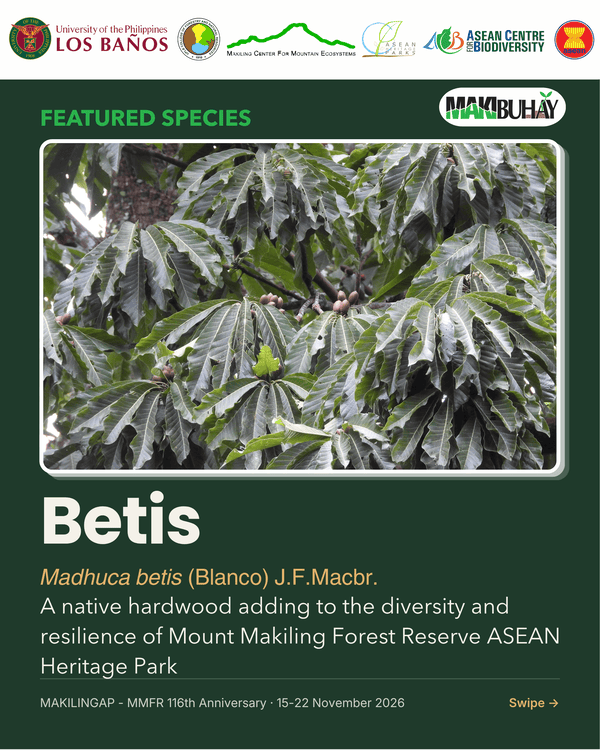
To mark the 116th anniversary of the Mount Makiling Forest Reserve (MMFR), the Makiling Center for Mountain Ecosystems (MCME) is featuring Betis (Madhuca betis (Blanco) J.F.Macbr.), a native hardwood that adds to the diversity and resilience of the Mount Makiling Forest Reserve ASEAN Heritage Park.
Once valued across the country for its tough timber, Betis has become endangered in the Philippines. Here is why it matters, how to recognize it, and how you can help bring it back.
Betis at a glance
| Common name | Betis |
| Scientific name | Madhuca betis (Blanco) J.F.Macbr. |
| Family | Sapotaceae |
| Conservation status | Endangered in the Philippines (DAO 2026-20); Vulnerable globally (IUCN) |
| Native range | Lowland rainforests of Luzon, Mindoro and Mindanao; also Borneo and Sulawesi |
| Size | About 30–35 m tall, with a trunk up to about 80 cm across |
A tree woven into Filipino life
Betis wood is hard, heavy, and termite-resistant. These qualities made it a traditional choice for wharves, bridges, house posts, and boats. Its seeds were useful too: the oil pressed from them was once burned for light.
The tree has even left its mark on a place name. Betis, the woodcarving district of Guagua, Pampanga, is reportedly named after a giant betis tree.
Why Betis needs our help
Logging, kaingin (slash-and-burn farming), and the loss of lowland forest have made Betis endangered in the Philippines. On top of that, it is rarely planted. That is why every Betis we grow back matters.
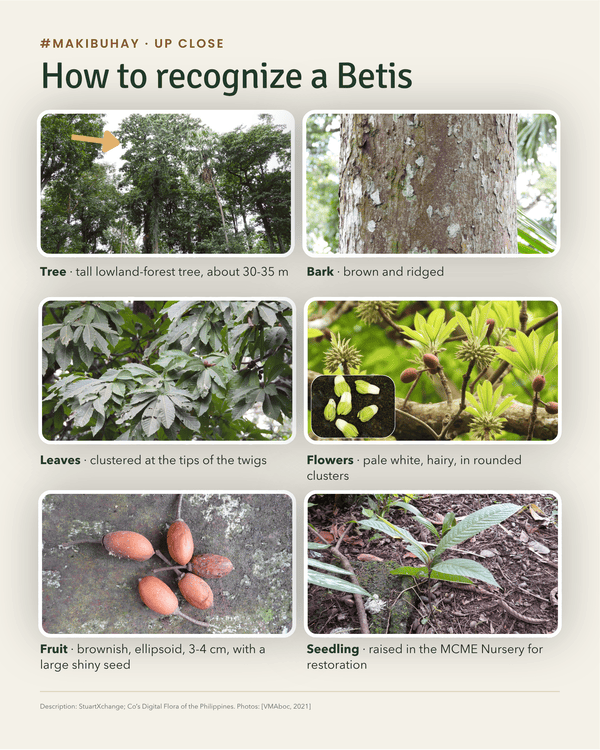
How to recognize a Betis
If you are walking through a lowland forest such as Mount Makiling’s, look for these features:
- Tree: a tall lowland-forest tree, about 30–35 m high.
- Bark: brown and ridged.
- Leaves: clustered at the tips of the twigs.
- Flowers: pale white and hairy, growing in rounded clusters.
- Fruit: brownish and ellipsoid (egg-shaped), 3–4 cm long, with a large, shiny seed.
- Seedlings: Betis seedlings are raised in the MCME Nursery for forest restoration.
From the MCME nursery to the slopes of Makiling
Betis is one of the native species MCME raises in its nursery for the Tree Planting and Nurturing (TPN) projects under its Corporate Partnership for Environmental Restoration Program (CoPERP). The program restores open areas and gaps in the Mount Makiling Forest Reserve.
The results are encouraging. Betis is contributing to the approximately 80% success (Year 1) of some of MCME’s restoration sites. In one example, Betis was planted with NX Logistics Philippines, Inc. alongside seven other native species on a site in Sitio Saimsim, Brgy. Sta. Elena, Sto. Tomas, Batangas, in August 2024.
Planting is only the beginning. Each restoration site receives:
- 4 years of nurturing for every planted site.
- Quarterly brushing, weeding, and monitoring.
- Local hands: community members help prepare and maintain the sites.
Grow the next Betis with us
Plant natives. Nurture them for four years. Watch a forest return.
Organizations can join CoPERP as part of their corporate social responsibility. MCME provides native seedlings, technical assistance, and coordination with nearby communities. Here is how to take part:
- Send a letter of intent to the MCME Director, Dr. Lerma SJ. Maldia.
- Meet the restoration team, then join a site inspection and sign a Memorandum of Agreement (MOA).
- Plant at least 2,000 native seedlings during the planting season (June to September).
Get in touch
Makiling Center for Mountain Ecosystems (MCME), College of Forestry and Natural Resources (CFNR), University of the Philippines Los Baños
- Email: mcme.uplb@up.edu.ph
- Viber call: +639088145993 (Mon-Fri, 8:00 AM-5:00 PM only)
- Facebook: www.facebook.com/makilingcenter
- Website: https://makiling.center/
Sources: Co’s Digital Flora of the Philippines; DENR DAO 2026-20; IUCN Red List (1998); PROSEA 5(1); StuartXchange.
#MakiBuhay is presented by the Makiling Center for Mountain Ecosystems, College of Forestry and Natural Resources of the University of the Philippines Los Baños
Enjoyed this post? Join the conversation on our Facebook page!
Follow us on Facebook